Add to Technorati Favorites

Tuesday, December 13, 2011

Christmas Rush – At the Capitol, not the Mall

Some members of the legislature are hell bent on adding to their list of attacks on protections of Wisconsin’s natural resources before the year is out. Confused by the bum-rush? That seems to be the intent. While we haven’t yet seen (as of today, anyway) an expected bill revising wetland protections, here are the two biggies:

1. Gutting Protections and Public Process for Mines

Assembly bill LRB 3520/1, written at the behest of an out-of-state mining company behind closed doors, dramatically weakens environmental protections, removes local citizens from the permit review process, and forces DNR to rubber stamp permits for new iron mines. Less than a week after the 183 bill saw the light of day, the Assembly will hold their public hearing in Milwaukee, more than 325 miles from the proposed mine site.

In a nutshell:

  • The bill and the process by which it is being rammed through the legislature takes away the voice of Wisconsin citizens.
  • It elevates mining above all other industries and businesses in the state, applying special rules that allow mines to bypass the environmental and public health requirements that apply to everyone else.
  • It takes science out of decision making, from preventing experts from questioning the mining company’s data to cutting the permit review time so short, DNR literally won’t have the time to review information and make valid decisions.

The hearing will be held at State Fair Park, Tommy Thompson Youth Center, beginning at 10:00.

2. Fast-Tracking Development in Lakes and Rivers

While conservationists are headed to Milwaukee to oppose the Assembly’s mining bill on Wednesday, December14, both the Senate and Assembly Natural Resource Committees will be voting on the controversial bill that “streamlines” the permit process for private projects in our public waterways.

The tremendous outpouring of concern by many of you to your legislators and at the public hearing in October did make a difference. The authors have removed many of the most blatant special interest giveaways, but the rotten heart of the bill remains. Now known as SB 326 in the Senate and AB 421 in the Assembly, the bill still:

  • Requires automatic approval for private projects in public waters;
  • Places the burden of proving a project will be harmful on neighbors instead of requiring the developer to prove it won’t;
  • Legalizes party decks and gazebos illegally built on lakes and rivers; and
  • Stops DNR from limiting pier construction in the state’s most sensitive shore areas.

The Assembly Committee on Natural Resources and the Environment will meet at 9:30 in Room 412E of the Capitol

The Senate Natural Resources Committee will meet at 10:00 in Room 300 SE.

No public testimony will be taken, but don’t let them take their votes out of the public eye. If you can’t make the mining hearing in Milwaukee, take a few minutes of your Wednesday morning to let the committee members know, we are watching.


Friday, October 21, 2011

It Finally Has a Name -- Even Two


Credit the Occupy Wall Street people with simplifying the complicated topic of the dominance of the bankers over the political system by naming the bankers the “One Percent” and the rest of us rats on this sinking ship the 99%. One photo Rat saw from the Wall Street occupation said it beautifully. It depicted a woman holding her granddaughter and a sign that read, “99% chance that you’re with us.”

Finding an easy way to explain how wealth has become skewed to the top of the economic food chain is hard to do without pummeling people with lots of numbers and arcane economic theory. But there are people – and from the mainstream academic world, not just a park bench in Manhattan – who are making this topic more accessible and interesting.

Rat recently found a rat hole in the swank new Wisconsin Institute for Discovery at UW-Madison, where I snuck in to overhear a talk by Yale University political scientist Jacob Hacker. Author of Winner Take All Politics, Hacker tossed out lots of numbers to explain the wealth disparity. The most salient: how the One Percent’s percentage increase in income since 1970 is six times higher than that for the rest of us. Another: 40% of all income increases in the U.S. since 1970 went to the One Percent.

The typical rat brain struggles with numbers, but also with big words. Rat hopes the big word “oligarchy” rings a bell with the 99% of Americans who are not the One Percent. Another academic, political economist Jeffrey Winters, of Northwestern University, has re-introduced that term to the political discussion, along with one he may have coined –the wealth defense industry.

Read his article http://www.the-american-interest.com/article.cfm?piece=1048. A useful complement to Hacker’s numbers, Winters’ narrative account of how the uber-rich have wired the political system (for them, the most important thing to do) to their considerable advantage, and they more wealth they amass, the more lawyers, lobbyists, right-wing think tanks and political contributions they deploy it to protect it.

You have to hope the powerful evidence these two scholars have assembled, paired with the gritty passion of the Occupy Wall Streeters, will give ordinary Americans, in their beleaguered status as the 99%, pause to ask how the country got where it is. Sure, it’s “the government,” but bad government is a byproduct of the oligarchy’s putting the wealth defense industry to work to manipulate government to its benefit.

Rat remains nonpartisan, so I will end this note about partisan politics. Both Hacker and Winters make it clear there is not one political party on which to hang the country’s financial crisis; both have the blood of the 99%’s ever-shrinking economic prospects on their hands. Sure, Republicans align much more with wealthy interests, but Democrats have abetted them at crucial times, and failed to explain to American voters, in real and honest terms, the threats to their economic self-interest.

Tuesday, October 18, 2011

Someone please put a lamprey on some congressmen


Rat was enjoying an August afternoon on the southern shore of Lake Michigan, near the Indiana Dunes National Lakeshore, with my rat-letts (offspring), who commented on how clear the water was, despite the fact the beach we were lounging on was right next door to heavily-industrialized Gary/Hammond/Chicago.

I hated to inform the young rats that in this particular instance, such clear water was probably a bad thing. Lake Michigan is being scrubbed sterile by trillions of quagga mussels, an invasive critter that devours the tiny plankton that the rest of this Great Lake's food system depends on. Elsewhere on the Lake Michigan shore, the clarity caused by the quaggas only encourages another scourge -- cladophora, a stringy variety of algae that creates a great green stinky mass when it washes up on shore.

But leave it to Congress to not only ignore how these invasives are destroying the Great Lakes, but try to pass a law that Rat officially dubs the Free Passport for Invasive Creatures Act. The proposed law would exempt ballast water (that's the water ships take in and dump out of their hulls to balance their loads) from pollution regulation, and makes it illegal for states to have tougher standards than federal ones. http://www.duluthnewstribune.com/event/article/id/211979/

This is a really bad idea. In its sponsors' defense of costs to the shipping industry, it totally ignores the billions of dollars of repair and maintenance costs and lost recreational revenues from the invasives that are fundamentally altering the Great Lakes.

For a fine, and very sobering, assessment of the weird paradox of how mussels are making the lakes both nutrient-rich and starving them of nutrients, and therefore messing with the entire system, see this new report from the National Wildlife Federation. http://www.nwf.org/News-and-Magazines/Media-Center/Reports/Archive/2011/Feast-and-Famine-in-the-Great-Lakes.aspx

The whole thing makes Rat want to loose sea lampreys upon those members of Congress supporting this bill. Also an invader to the Great Lakes via the Atlantic Ocean, lampreys attach themselves (that's the mouth of one in the picture up there) to their victims and eventually suck them dead. Lampreys know only cold-blooded animals, so as far as members of Congress go, that definitely works.

(This bill was passed out of House Transportation and Infrastructure Committee last week on a voice vote, so it's hard to know how the two Wisconsin members serving on that committee -- Rep. Reid Ribble and Rep. Tom Petri -- voted on the measure. When Rat's moles find out, we'll let you know.)

Wednesday, October 5, 2011

A Nasty Trail of Mining Dirt


As a rat, I have a deep appreciation for cunning and admire a bit of deviousness. After all, that’s how my kind has survived in this rough, sometimes unfriendly world. But even I was taken aback by the latest high jinks in the hallowed halls of the state capitol, and the doublespeak and outright lies by those who stand to gain.

Unless you’ve been living under a rock (or should I say in deference to my many friends who do indeed live under rocks, blissfully oblivious to state news), there has been much ado about a renewed interest in mining in Wisconsin, and a giant, out of state corporation has made known their intent to create an enormous open pit taconite mine in Ashland County. Couched in the tired old cliché that environmental protections kill jobs, there has been much rhetoric about how state laws protecting water resources undermine the potentially vast economic boon that open pit mining could bring to Wisconsin.

In spring, a terrible bill completely undermining environmental protections and clearly written by the mining industry was leaked to the public but was never formally introduced. Just last week, blithely ignoring the well-documented history of boom and bust cycles accompanying mining operations around the world, and without questioning the mining company’s assertion of how many local jobs their operation would actually create, the state senate has created their “Select Committee on Mining Jobs” to look at “streamlining” the state’s mining laws.

First there was a bit of a kerfuffle over who would be appointed to the select committee. The Democrat legislators recommended to join the committee were rejected by the Republican leadership. Then a day later, the recommendations were accepted after all. But that very same day, the Guv introduced a special session (and we all remember the last one, don’t we?) called “Back to Work Wisconsin.” Buried in the long list of bills touted as helping to create jobs are proposals to revise state laws guiding protection of wetlands and streams. There are no details yet, but you can bet they’ll be chock full of many of the exemptions the mining company hoped to achieve through their bill this spring. Suddenly it all makes sense – who cares who’s on the Senate Select Committee on Mining Jobs? After these special session bills, they won’t have much to talk about anyway!

And then there’s the mining folks. The Wisconsin Mining Association, a self-proclaimed non-partisan organization reconstituted from the dark days of debate on the Crandon Mine that had been proposed at the headwaters of the Wolf River, hosted a press conference to proclaim their fervent belief that job creation and environmental protection go hand in hand. They issued a list of catchy “principles” including this kicker: “The Wisconsin Mining Association believes that facts matter.” Well, that’s certainly comforting. Unfortunately they don’t seem compelled to actually use them.

They also issued their list of key elements of new mining legislation, prefaced by a totally fabricated history of the current mining law. They flatly state, “Wisconsin’s mining laws were written for sulfide mines.” According to the Legislative Reference Bureau, the non-partisan record-keeping arm of the legislature, the fact is that current laws were written for all metallic mining, with a special emphasis on taconite mining! As a result of the Crandon mine debate, the law was amended to add an extra step for proposed sulfide mines, but that step does not apply to taconite mine proposals. There is absolutely no need to change our current laws to ensure the efficient review of a taconite mine proposal. The real issue is that an enormous, deep mine in the Penokee hills could not possibly proceed without utterly devastating the water resources of the region, and the changes demanded by the Wisconsin Mining Association and their cronies in the legislature are to allow just that.


posted by the River Rat

Tuesday, September 13, 2011

Cry A River for the Paper Industry?

Never did this Rat expect to write a salutation to the Wisconsin paper industry, given how it dumped billions of gallons of toxic waste in Wisconsin’s rivers and constipated them with their dams. We are still cleaning up after the industry on the Fox River, getting rid of toxic PCBs from the mud and muck of that fabled river.

Last week we learned that New Page, an Ohio company that owns four paper mills in Wisconsin – oh, make that three now, but it had been four up until February, and as many as six a few years ago – filed for bankruptcy. It is staring at over $3 billion in debt.

The latest plant to be shuttered by New Page was their facility in Whiting, near Stevens Point. 360 jobs gone.

Given this industry was a voracious tree-eating, pollution-spewing monster parked on the state’s major rivers, do we even cry a river for them?

Yes. Despite its history of resource abuse, the paper industry cleaned up its act. It required a federal law and state enforcement to do it, but they got there. The Wisconsin River is a recreational gem these days, a possibility unheard of in 1970. Even the bedraggled and dumped-upon Fox River is being rehabilitated, its image improving yearly as the water quality improves in kind.

But not just on the river but out in the woods too we have decried the paper industry – all those trees cut, all that forestland ravaged. Even though industrial forests are treated like cornfields, that land once provided wildlife and bird habitat is now being cut up into 40-acre hunting plots and disrupting the continuity of that land that made for such good habitat. Many are lamenting the loss of the big forest tracts, for the sake of the birds.

Consolidated Papers was the kingpin of Wisconsin paper. Its empire was strung up and down the Wisconsin River and far afield into northern Wisconsin, where it raised and cut the pulp to feed its mills. It was a community-minded corporate citizen, helping build facilities and parks in the communities it had plants in and providing family-supporting wages. (Most paper plants in the Wisconsin and Fox river valleys were unionized.)

When Consolidated sold to Stora Enso, a Finnish company, in 2000, you could hear the dominoes getting stacked up, foretelling what was to come. By 2007, Stora Enso sold the mills it had bought from Consolidated at Biron, Wisconsin Rapids, Whiting, Niagara, Stevens Point and Kimberly. The first domino dropped in Niagara (320 jobs), where the rusting hulk of that mill looms over the small town like a metallic alien crashed into the river bluff. (Check out the picture.) Kimberly was next (600 jobs), and just this year, the plug was pulled at Whiting (360 jobs). Biron, Stevens Point and Wisconsin Rapids are still operating, but with dark clouds over their smokestacks.

Wisconsin had the key ingredients to make a paper industry – trees, moving water, and hard-working people. The trees have grown back, the rivers have largely recovered, but good-paying paper mill jobs are gone. Some of it is due to cheaper raw material and labor in Asia. Some of it is due to paper industry greed and shortsightedness. Some of it is due to the very device through which you read this essay – the paperless Internet.

For many reasons, especially how a healthy paper industry helped many Wisconsin communities and families prosper over the decades, we should lament its demise.

Wednesday, August 24, 2011

Fair Thee Well Alicia Rae

Rat recently swam over to Milwaukee and from the harbor watched as the Alicia Rae, the last working commercial fishing boat in Milwaukee, left Milwaukee for good.

Lake Michigan has been evicting commercial fishers for many years. The lake’s ecology keeps changing with the continued introduction of invasive species mostly by way of ballast water in large Great Lakes shipping vessels. It’s difficult to blame just one culprit since the story of various species invading Lake Michigan waters and the resulting rise and fall of dominant fish populations is beginning to read like a volume on European history.

But if Rat were to point a pointy-clawed digit at today’s main offender, I would come up 900 trillion digits too few, for those quagga mussels sure are prolific little buggers. I should say prolific little morsels, but my poor belly hurts just looking at them all.

Dan Egan wrote a bittersweet piece in the Milwaukee Journal Sentinel about Dan Anderson, the captain of the Alicia Rae, and his story of leaving the Lake Michigan fishery behind. Or as Dan put it, “The lake left me. It’s gone.”

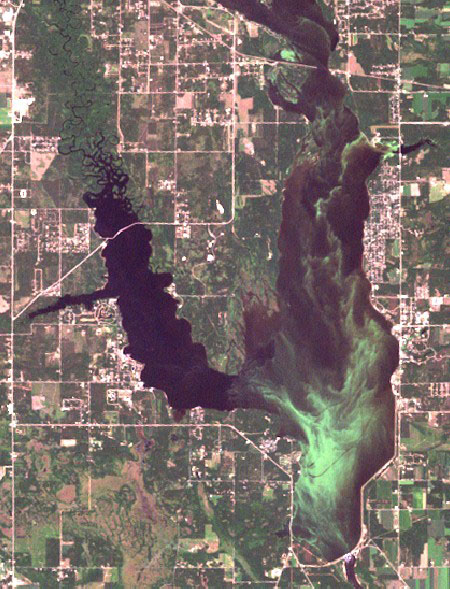
The rivers that Rat calls home, like Lake Michigan, could use some help battling invasive species, and someone could really lend a paw to help battle all that oppressive algae that’s been blooming this summer. (Not to mention my fur; it’s startin’ to stink!) After all, we wouldn’t want to read stories of businesses people dependent on rivers saying things like, “The river left me. It’s gone.” Would we?

Photo: Satellite view of an algae bloom in Castle Rock Lake on the Wisconsin River. Courtesy of UW SSEC and WisconsinView


Wednesday, August 3, 2011

Wiscosnin DNR B-slapped by federal agents

That's BUREAUCRAT-slapping, just so we're clear here. Rat's use of crude vernacular is against its code of rat ethics.

But the bureaucrat-slapping of the Wisconsin Dept. of Natural Resources by fellow bureaucrats of the U.S. Environmental Protection Agency is remarkable, for the no-nonsense thoroughness of the communique, and for the fact that it was even written.

On July 18, the EPA's Chicago office informed the DNR that it has found "numerous apparent omissions and deviations" from how DNR is supposed to enforce clean water laws.

In fact, EPA slapped DNR a total of 75 times for various omissions and deviations. In effect, EPA is telling DNR: "You are blowing off federal law and we're not happy about it." Some examples:

  • EPA tells DNR that it is too restrictive in who they allow to make a legal challenge of a water permit. They point out that Wisconsin lacks clear-cut ways for the public to participate in DNR's water pollution enforcement process.
  • EPA tells DNR that it can't let the state's transportation department off the the hook from controlling erosion at road construction sites: "Wisconsin cannot simply exempt DOT projects from [stormwater] permitting requirements."
  • EPA contends DNR is letting the fox of municipalities watch over the hen house of their own stormwater programs.
There are 72 more.

EPA asks DNR to respond to this letter by mid-October. For scores of these deficiencies, its communique asks the agency to "include a plan, with schedule and milestones," for how DNR will comply with federal law. EPA is even asking for new administrative rules and statutes for some of these deficiencies. (Guess EPA hasn't been hanging around Wisconsin in recent months, where old environmental laws are being gutted, and new ones have as much chance as a rat at a cat convention.)

This EPA letter indirectly stems from a Wisconsin Supreme Court ruling last spring which said, in effect, that the DNR didn't have to carry out certain provisions of federal clean water laws unless the EPA specifically ordered it. This appears to be that order.

The rat-paw prints of fellow river rats at Midwest Environmental Advocates are all over this opus from EPA. EPA cannot be dictated to, of course, but MEA has been sure to keep EPA apprised of the slippage we all have observed over the years in Wisconsin DNR's consistently and evenly enforcing clean water laws.